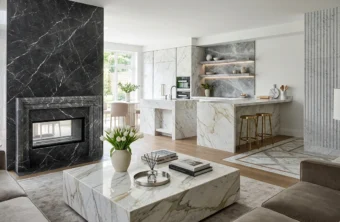
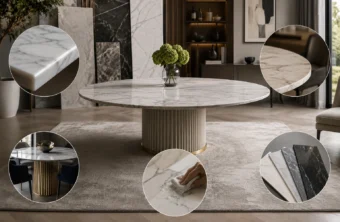
What truly sets marble apart from any other surface material is its one-of-a-kind veining patterns. Each slab tells a geological story formed over millions of years through heat, pressure, and mineral transformation. In a sense, marble veining is nature’s own abstract artwork.
🌿 The Origin of Marble Veins
Marble veins are created by natural mineral deposits that formed during the stone’s transformation process. Variations in temperature, pressure, and mineral composition create unique lines, waves, and patterns inside each slab.
No two pieces of marble are ever identical—this is what makes it so valuable and artistic.
Most Famous Vein Patterns
Carrara Marble (Soft Grey Veins)
- White background with delicate grey veining
- Smooth, cloud-like movement
- Creates a calm and balanced visual effect
Nero Marquina (Bold Contrast)
- Deep black background with sharp white veins
- High contrast, dramatic appearance
- Often used in modern luxury interiors
Calacatta Marble (Strong Statement Veins)
- White base with thick, bold grey veining
- More dramatic and expressive than Carrara
- Ideal for focal design pieces
Portoro Marble (Luxury Gold Veins)
- Black background with golden veins
- Highly decorative and luxurious
- Often used in premium statement designs
🎨 Types of Veining Structures
Marble veins can be categorized into different visual structures:
- Fine and delicate lines
- Thick and bold movements
- Random chaotic patterns
- Net-like (webbed) structures
- Linear directional flows
Each type creates a completely different visual atmosphere.
🧭 Direction of Veins Matters
The orientation of marble veining significantly affects interior design:
- Horizontal veining: Creates a calm and grounded look (ideal for countertops)
- Vertical veining: Makes spaces feel taller and more dramatic (ideal for wall cladding)
- Random veining: Emphasizes natural and artistic expression (ideal for coffee tables and decor pieces)
☀️ Light and Surface Finish Interaction
Veins change appearance depending on lighting and finish:
- Polished surfaces: Veins appear sharper and more defined
- Honed (matte) surfaces: Veins look softer and more natural
- Natural light enhances depth and movement within the stone
🖼️ Nature as Abstract Art
From a distance, marble veining often resembles abstract paintings, landscapes, or flowing water. Some even perceive shapes like figures or symbols within the stone. This artistic randomness is part of marble’s unique charm and value.
📸 Why Slab Selection Matters
Because every slab is unique:
- Always request slab photos before purchase
- Compare multiple pieces to find the right pattern flow
- Ensure consistency if multiple slabs are used in one project
This step is essential in custom interior design projects.
Final Thoughts
Marble veining is not just a design feature—it is nature’s signature. Every slab is a one-of-a-kind artwork formed over millions of years, making marble one of the most artistic materials used in architecture and interior design.
Choosing marble is essentially choosing a piece of natural history turned into visual art.