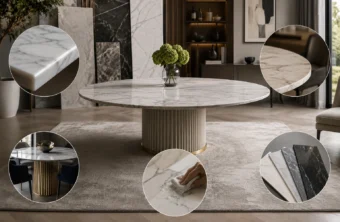
In today’s market, you’ll often find both natural marble and engineered alternatives such as quartz, agglomerated stone, or cultured marble. While they may look similar at first glance, their structure and performance are quite different.
Here are the 7 most important differences you should know:
1. Composition
- Natural Marble:
100% natural stone, formed over millions of years and only cut and polished.
- Engineered Marble / Quartz:
A mixture of crushed stone (marble or quartz) combined with resin and pigments.
👉 One is natural geology, the other is manufactured.
2. Appearance and Pattern
- Natural Marble:
Every slab is unique with completely one-of-a-kind veining patterns.
- Engineered Stone:
Designed patterns that repeat and appear more uniform.
👉 Natural marble = unique artwork
👉 Engineered stone = controlled design
3. Porosity
- Natural Marble:
Porous and requires sealing to prevent staining.
- Engineered Stone:
Non-porous surface, highly resistant to staining.
4. Scratch Resistance
- Natural Marble:
Softer stone (Mohs hardness 3–4), more prone to scratches.
- Quartz (Engineered):
Very hard (Mohs ~7), highly scratch-resistant.
5. Heat Resistance
- Natural Marble:
Excellent heat resistance (hot pans can be placed with caution).
- Engineered Marble/Quartz:
Resin content may be damaged or discolored by high heat.
6. Acid Resistance
- Natural Marble:
Sensitive to acids like lemon, vinegar, and wine (can cause etching).
- Engineered Stone:
Much more resistant to acids and everyday kitchen chemicals.
7. Price and Long-Term Value
- Natural Marble:
Can be expensive depending on rarity and may increase in value over time.
- Engineered Stone:
Generally more affordable but has little to no resale value.
Which One Should You Choose?
- Choose natural marble if you want:
- Luxury appearance
- Unique, natural patterns
- Timeless aesthetic value
- Choose engineered stone if you want:
- Low maintenance
- High scratch and stain resistance
- Practical everyday kitchen use
👉 Quartz is often preferred for busy kitchen countertops, while natural marble is favored for luxury interiors, bathrooms, and decorative applications.
Final Thoughts
Both materials have their strengths, but they serve different purposes. The choice depends on whether you prioritize natural beauty and uniqueness or durability and practicality.
At the core, natural marble remains unmatched in character—because nature cannot be replicated.